
Background
For those who are unaware of the evolutionary history of reptiles and wondering how snakes came to be, you’re looking at one of biology’s most famous mysteries. Snakes belong to a massive group of reptiles called Squamates, which include every lizard and snake species alive today. That’s more that 10,000 species in one order alone!
For years, scientists and researchers understood that snakes evolved directly from lizards. The working theory was that lizards gradually lost their limbs and developed highly specialized features, like their incredibly flexible jaw-stretching anatomy. Because the fossil record from the Jurassic period is so incomplete, finding a clear “in-between” animal that shows these snake features developing in a lizard-like body is one of the main goals of paleontologists.
Meet the False Snake of Eglog
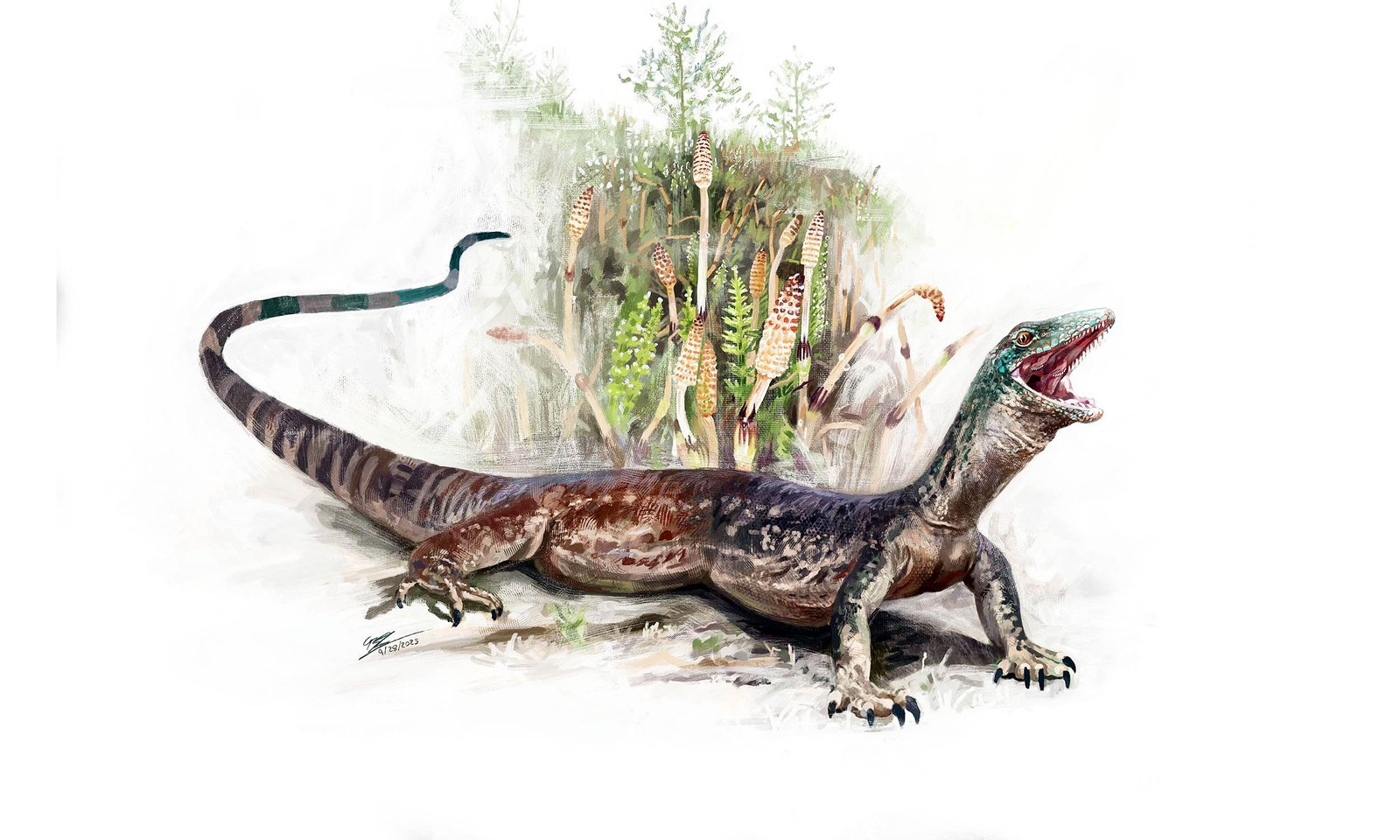
Recent fossil discovery has scientists scratching their heads and rewriting the evolutionary timeline. Unearthed on Scotland’s fossil-rich Isle of Skye, paleontologists Dr. Stig Walsh of National Museums Scotland introduced us to Breugnathair elgolensis, a 167-million-year-old reptile that is shaking up the foundation of the Squamate family tree. This “Frankenstein” of the Jurassic period, has a the short body and four limbs of gecko-like lizard, yet equipped with the elongated jaw and sharply curved, hook-like teeth of a modern python. This combination of traits, where snake and lizard features appear mixed together, earning the perfectly fitting Gaelic name: “false make of Elgol.”
Buy One Get One Free – Reptile Edition
This fossil, one of the most complete Jurassic lizards ever found, presented a decade-long puzzle for researchers. The fossil was first discovered in 2016, but it took around a decade of research for the picture to become clear. Initially, some paleontologists believed the scattered fragments must have belonged to two separate animals: a lizard and a primitive snake. Why? Simply because the anatomy seemed too contradictory for one creature. However, advanced imaging techniques, including high-powered X-rays and computed tomography (CT) imaging confirmed that this was one animal.

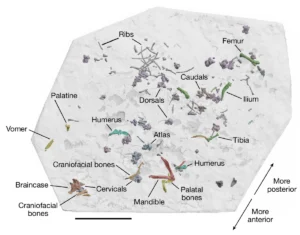
Measuring roughly 40 centimeters (16 inches) long, about the size of a small cat, Breugnathair was one of the largest lizards in its ecosystem in the Jurassic period. It likely used those formidable, snake-like jaws and recurved teeth to prey on smaller lizards, early mammals and possibly even younger dinosaurs. With this, they dominated its niche with a primitive, yet highly specialized, predatory hunting and feeding style.
Snake Evolutionary History Rewritten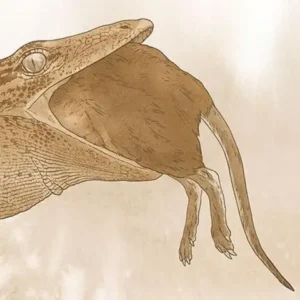
The existence of Breugnathair challenges a simple, linear path of evolution. It shows that the specialized jaw structures we associate with modern snakes (i.e. Pythons) developed much earlier and in more diverse branches of the Squamate family than previously assumed. Could Breugnathair be a direct, lizard-like ancestor of snakes? Or is it a stem-Squamate, an ancestor of all modern lizards and snakes, that independently evolved those specialized teeth? The answer remains inconclusive, as of right now, but this fossil and discovery adds to the proof that evolution is messy, unpredictable, and not linear.
Takeaway From This Discovery
For future veterinarians, zoologists, and wildlife enthusiasts, this discovery is a perfect reminder that our understanding of anatomy and evolutionary relationships is constantly evolving, When studying comparative anatomy, it’s easy to assign traits to specific groups, but Breugnathair elgolensis shows that mosaic anatomy (the mixing of primitive and advanced features) was widespread. The next time you study/observe snake jaws or lizard limbs, remember the “false snake of Elgol,” whose very existence forces scientists to rethink around two centuries of reptile history.